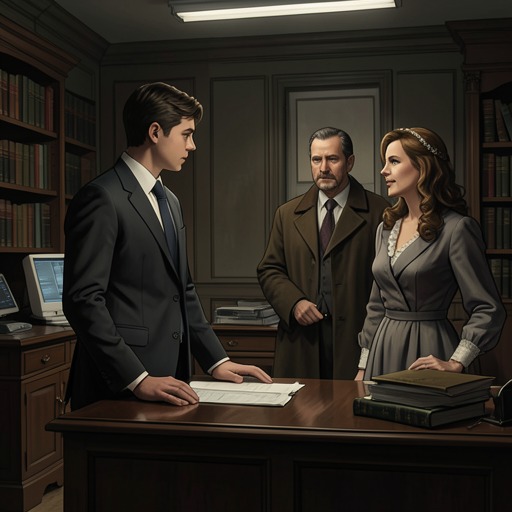
The Ambassador's Boots
Partners in CrimeThe Ambassador's Boots is the investigation in which Tommy Beresford discovers that a supposed mix-up involving the American Ambassador’s luggage was a cover for cocaine smuggling. Its decisive turn comes when Tommy reverses the apparent logic of the case: the point was not to steal the Ambassador’s bag, but to place another bag in the Ambassador’s possession long enough to exploit the exemption of diplomatic luggage from Customs examination. The trail ends in a wall safe concealing cocaine beneath tins of bath salts, and with a wanted man in police custody.
The Impossible Kitbag Exchange
The case begins with Mr. Wilmott’s account of an apparently ordinary error aboard the liner Nomadic. A week earlier, he says, his kitbag and the nearly identical bag of Senator Ralph Westerham had been confused because both carried the initials R.W. Westerham supposedly took Wilmott’s bag by mistake, then discovered the error, returned Wilmott’s bag to the Embassy, and reclaimed his own. Wilmott himself says he did not learn of the exchange until his valet told him what had happened.
The story collapses when Wilmott later meets Westerham and mentions it. The Senator denies the exchange outright: he had not taken Wilmott’s bag, and had not travelled with such a piece of luggage. The contradiction turns a minor mishap into the real puzzle. If the bag had been stolen, Wilmott observes, there would have been no need for such an elaborate roundabout arrangement; yet it had supposedly been returned. He hires Tommy to get to the bottom of a business that seems to have no rhyme or reason.
The Bag That Needed to Travel
Tommy’s solution depends on changing the question. Rather than asking why anyone would want the Ambassador’s bag for an hour, he asks why someone would want the other bag to be in the Ambassador’s possession for that hour. The distinction exposes the exchange as a means to an end: diplomatic luggage was not subject to Customs examination, so arranging for a particular bag to pass briefly as the Ambassador’s could facilitate smuggling.
The bags’ mistaken identity is therefore not the crime’s objective but its mechanism. Wilmott and Westerham’s matching initials and nearly identical kitbags make the alleged mix-up plausible on its face; Westerham’s denial reveals that this plausible explanation was manufactured. Tommy reasons that the contents must be compact enough to suit the plan and identifies drugs as the likely cargo. What initially looked like an inexplicable theft followed by an inexplicable return becomes a calculated way of borrowing diplomatic immunity for a bag.
A Distraction, Then a Witness
A staged comedy at Tommy’s office is meant to derail the inquiry. The conspirators have seen his advertisement and try either to put him off the scent or remove him from the case. Tommy notices that the charming woman involved looks blankly dismayed when Albert performs his lasso act. Her reaction does not fit the role she is meant to be playing, while the stranger’s attack is designed to secure Tommy’s confidence in her. Tommy responds by acting like a credulous detective: he accepts her improbable account and allows her to lead him to the next location, but leaves full instructions behind and delays the journey to give the police time to act.
Cicely March supplies a crucial account of what happened aboard the ship. She says that Miss O’Hara was also a passenger on the Nomadic, and that she once saw her inside the American Ambassador’s cabin holding a man’s boot. Using small scissors, Miss O’Hara slit the boot lining and pushed something inside. When a doctor and another man approached, she dropped onto a couch and groaned as if faint; March says that the woman had not appeared to be ill before their arrival. The scene links the luggage puzzle to an object concealed within diplomatic baggage and adds a second performance of false appearances to the case: the supposed faint is as staged as the apparent kitbag mistake.
Bath Salts and the Police Coup
The final search turns a respectable beauty-shop setting into the discovery point of the smuggling operation. A small wall safe stands in a corner with its key in the lock. When Tommy opens it, the back swings into a large recess in the wall, stacked with rows of elegant bath-salt tins. The contents disguise their purpose: beneath pink crystals is a fine white powder. The Inspector identifies the powder as almost certainly pure cocaine and says the police had known a distribution area existed somewhere near the West End but had found no clue to its location.
Tommy’s explanation connects the hidden stock to the false luggage story and the diversion at his office. In his account, the conspicuous comedy was meant to stop him pursuing the advertisement, while the woman’s apparent distress and the stranger’s attack were coordinated performances. The operation’s logic is revealed not by any single bag or tin alone, but by the way they fit together: diplomatic luggage can evade inspection, an invented exchange can place the desired bag with the Ambassador, and concealed drugs can move behind an innocuous surface. Inspector Grace and another officer arrive with Tuppence and take the wanted man into custody; Tommy’s precautions have allowed the police to be waiting when the deception is exposed.
Resolution and Material Clues
The investigation’s chain of reasoning is built from ordinary objects whose uses are altered by concealment. A kitbag carries the false history of an exchange; a boot lining hides a small object; bath-salt tins mask cocaine; and a safe appears to be only a small wall fixture until its false back opens onto a much larger recess. The case repeatedly asks the reader to look past what an object seems to be carrying—or what a person seems to be doing—and to consider what the arrangement makes possible.
The ending restores the episode to Tommy and Tuppence’s partnership and its domestic wit. Emerging into the street after the discovery, Tommy calls it a triumph for Blunt's Brilliant Detectives and credits Tuppence’s persistent schooling with teaching him to recognize peroxide; he says that genuine golden hair would still have taken him in. He proposes a businesslike letter to the Ambassador confirming that the matter has been dealt with, then turns from the successful police coup to tea and hot buttered muffins. The contrast does not undo the seriousness of the cocaine discovery. Instead, it gives the resolution its characteristic rhythm: intricate criminal misdirection is dismantled through patient attention to details, then set aside for the couple’s familiar banter and ordinary comforts.